Corrected Age vs. Actual Age: Understanding Your Twins' Development
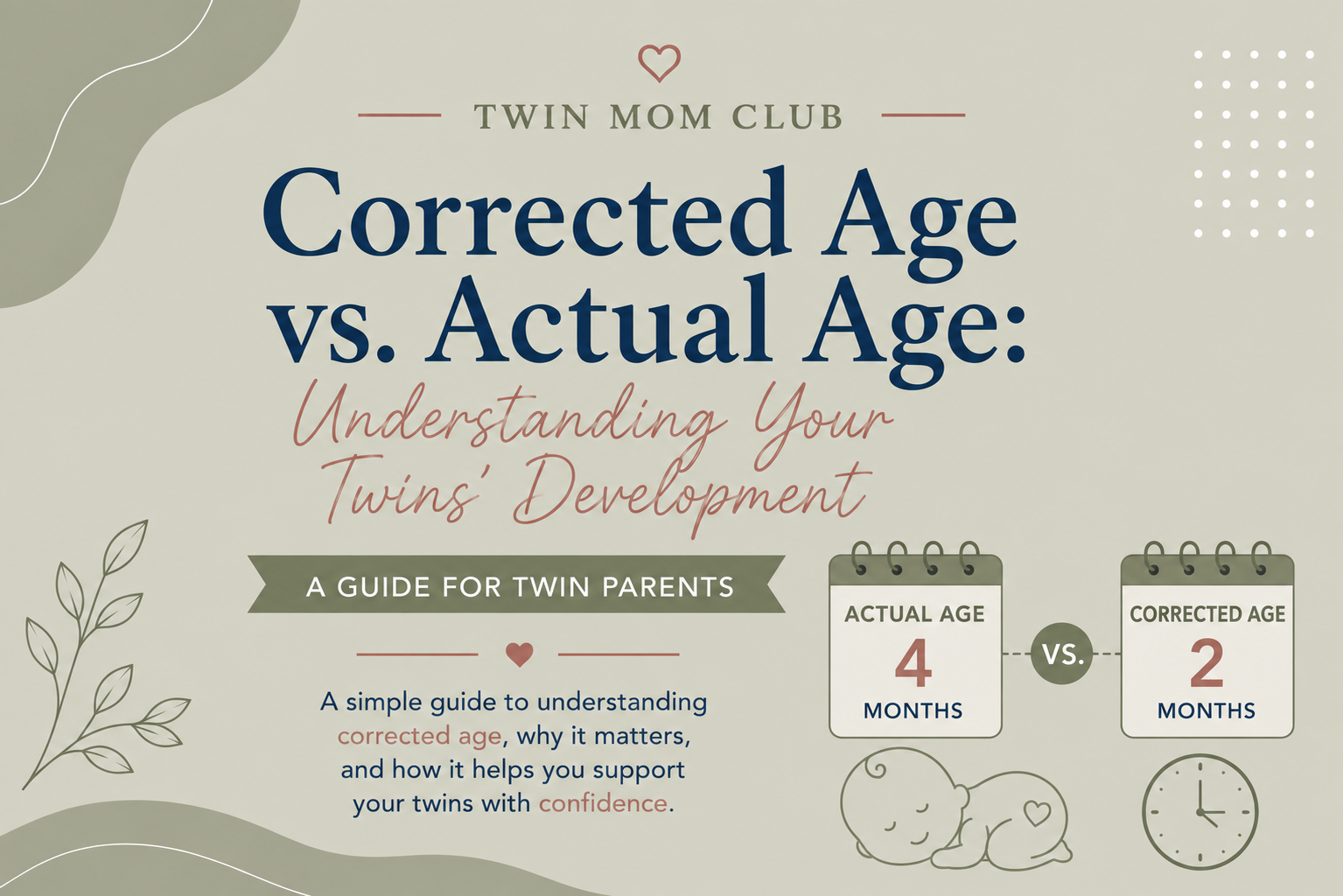
If your twins were born prematurely, you'll probably hear healthcare providers talk about both actual age and corrected age.
At first, it can feel confusing.
One doctor may say your babies are four months old, while another says they're only two months old developmentally. Which one is correct?
The answer is...both.
Understanding corrected age helps you set realistic expectations for your twins' growth and developmental milestones. It also prevents unnecessary worry when your babies aren't doing the same things as full-term babies their actual age.
💙 Twin Parent Tip
If your twins were born before 37 weeks, ask your pediatrician whether you should be tracking milestones using corrected age. For many premature babies, this is the best way to evaluate development during the first two years of life.
What Is Actual Age?
Actual age, sometimes called chronological age, is simply the amount of time that has passed since your babies were born.
For example:
Born on January 1
Today is May 1
Your twins' actual age is 4 months.
This is the age you'll use for birthdays, immunizations, and many everyday activities.
What Is Corrected Age?
Corrected age adjusts your baby's age based on how early they were born.
Instead of counting from the birth date alone, corrected age starts from your babies' original due date.
This gives premature babies credit for the time they would have still been developing in the womb.
Because many developmental milestones depend on brain and body maturity, corrected age provides a more accurate picture of what your babies may be ready to do.
How Do You Calculate Corrected Age?
The calculation is simpler than it sounds.
Step 1
Determine how many weeks early your twins were born.
For example:
Due date: 40 weeks
Birth: 32 weeks
Your twins were born 8 weeks early.
Step 2
Subtract those weeks from your babies' actual age.
If your twins are:
4 months old (approximately 16 weeks)
Born 8 weeks early
Their corrected age is approximately 2 months.
Why Corrected Age Matters
Premature babies often reach milestones based on their corrected age rather than their birth date.
For example, if your twins were born two months early, it would be unrealistic to expect them to have the same developmental skills as full-term babies born on the same day.
Using corrected age helps healthcare providers evaluate:
Growth
Feeding skills
Motor development
Communication
Social development
Corrected age creates a fair comparison by accounting for prematurity.
Which Milestones Use Corrected Age?
Most pediatricians and developmental specialists use corrected age when evaluating:
Smiling
Rolling over
Sitting
Crawling
Walking
First words
Feeding development
This helps prevent babies from being labeled as "delayed" when they're actually developing appropriately for their adjusted maturity.
What About Growth Charts?
Many healthcare providers also use growth charts designed specifically for premature babies during the early months.
Eventually, your twins will transition to standard growth charts as they get older.
Your pediatrician will decide which charts are most appropriate based on your babies' gestational age and medical history.
When Do You Stop Correcting Age?
Most healthcare providers stop using corrected age around 2 years old.
By this point, many premature children have caught up to their full-term peers in growth and development.
Some babies born extremely prematurely may continue receiving developmental follow-up beyond age two, but corrected age is generally no longer used for routine milestone tracking.
Try Not to Compare Your Twins to Other Babies
It can be tempting to compare your twins to babies born around the same time.
Remember that babies born prematurely started life with a very different timeline.
Even identical twins may reach milestones days or weeks apart from each other.
Rather than focusing on comparisons, celebrate each new skill your babies develop.
Progress matters much more than perfect timing.
When Should You Be Concerned?
Corrected age is helpful, but it doesn't mean developmental concerns should be ignored.
Talk with your pediatrician if you notice:
Difficulty feeding
Poor weight gain
Very low muscle tone
Loss of previously learned skills
Concerns about hearing or vision
Delays that continue even when using corrected age
Early intervention services can provide valuable support whenever concerns arise.
My RN & Twin Mom Perspective
One of the easiest ways to create unnecessary stress is by comparing babies to milestone charts without considering whether they were born early.
As a registered nurse, I know corrected age gives healthcare providers a much more accurate picture of development for premature babies. It's one of the reasons pediatricians ask about gestational age during well-child visits.
As a twin mom, I also know how easy it is to compare not only your babies to other children, but to compare your twins to each other. Even twins who share the same birthday can reach milestones at different times, and that's often completely normal.
Development isn't a race. Every milestone is worth celebrating, no matter when it happens.
🗣️ SLP Perspective from Dr. Judy
Corrected age is especially important when evaluating feeding and communication development.
Premature babies often need additional time to develop the coordination required for feeding, as well as the speech and language skills that follow during infancy and toddlerhood.
Using corrected age helps therapists and healthcare providers set realistic expectations while identifying children who may benefit from additional support.
Frequently Asked Questions
Do all premature babies use corrected age?
Most babies born before 37 weeks benefit from using corrected age during developmental evaluations, although your pediatrician will determine what's appropriate for your child.
Do twins always need corrected age?
No. Twins born at full term generally do not need corrected age. It is primarily used for babies born prematurely.
Does corrected age affect vaccinations?
No. Vaccinations are typically given based on your baby's actual age, not corrected age.
Can one twin develop faster than the other?
Yes. Even twins born on the same day often reach milestones at different times. Small differences in development are completely normal.
When should I stop using corrected age?
Most healthcare providers stop correcting for prematurity around your child's second birthday, although some children born very prematurely may continue developmental follow-up for longer.
Related Guides
Preparing for a Twin NICU Stay
Your First NICU Visit
NICU Terms Every Twin Parent Should Know
Bringing Twins Home from the NICU
Twin Baby Development Milestones
References
American Academy of Pediatrics. HealthyChildren.org.
Centers for Disease Control and Prevention. Learn the Signs. Act Early.
March of Dimes. Premature Babies.
MedlinePlus. Premature Infant Development.
Medical Disclaimer
This article is for educational and informational purposes only and should not be considered medical advice. Every child develops at their own pace. Always discuss your twins' growth, development, and milestone concerns with your pediatrician or healthcare provider.
