Teaching Twins to Share: What Actually Works (and What's Normal)
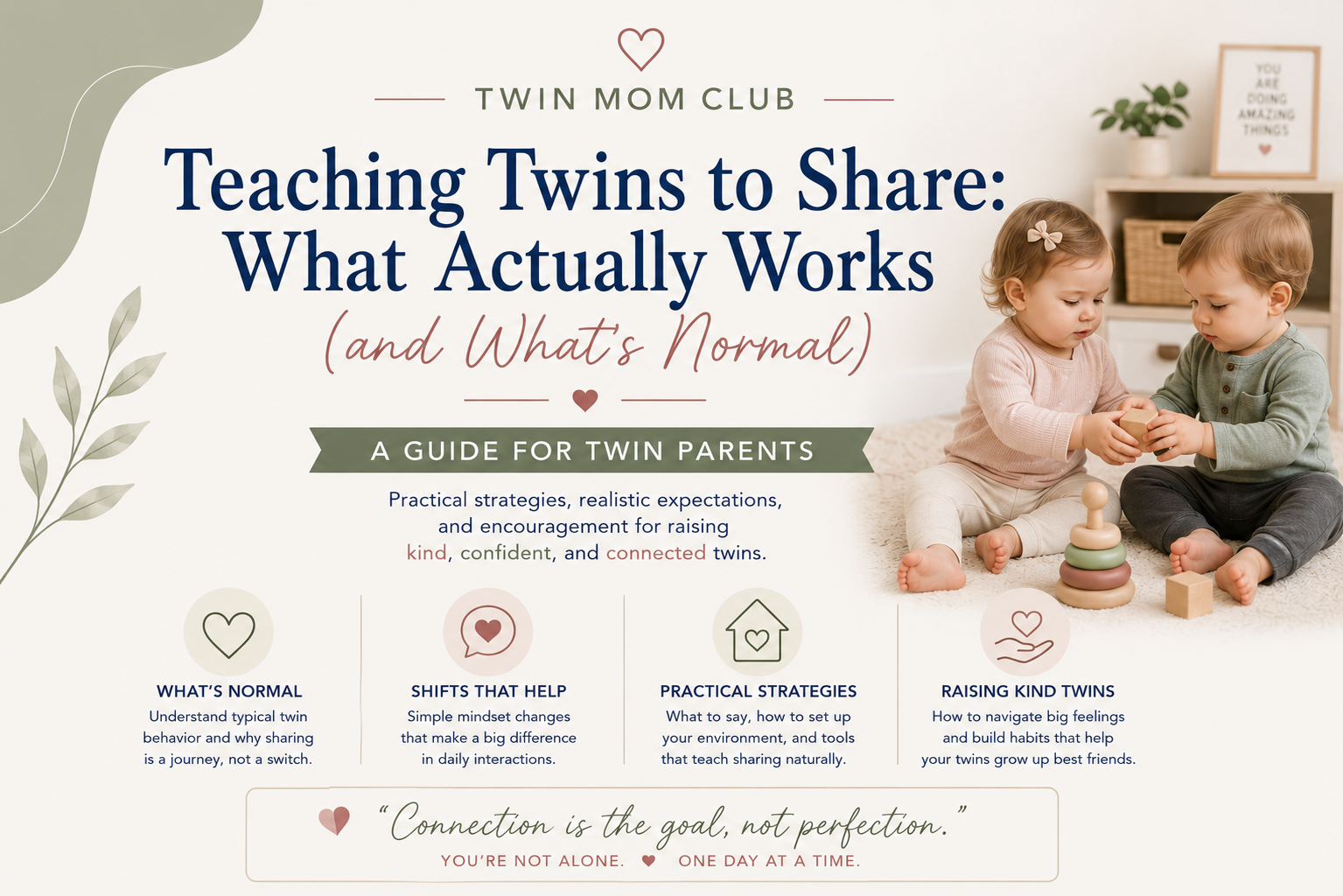
One of the biggest myths about raising twins is that they'll naturally learn to share because they're together all the time.
I wish it worked that way.
The reality is that twins have more opportunities to practice sharing, but they also have more opportunities to argue over the exact same toy. If one twin suddenly becomes interested in something, it's almost guaranteed the other one will want it too.
The funny part is that my twins only recently started truly playing together. Before that, they mostly played beside each other. Now they chase each other around the house, play peekaboo across their car seats, and my daughter wakes up every morning asking, "Bubba?" because she can't wait to find her brother.
Watching their relationship grow has been one of my favorite parts of toddlerhood. Along with that closeness has come plenty of opportunities to learn one of life's hardest lessons for toddlers: sharing.
The good news is that sharing is a skill, not a personality trait. Like every other developmental milestone, it takes time, patience, and lots of practice.
Is It Normal That My Twins Don't Want to Share?
Absolutely.
Most toddlers are naturally focused on meeting their own needs.
Their brains are still developing important skills like:
Taking turns
Waiting patiently
Understanding another person's perspective
Controlling impulses
These abilities continue developing throughout the preschool years.
Not wanting to share at age two doesn't mean your child is selfish.
It means they're two.
Why Sharing Can Be Harder for Twins
Twins live together.
They play together.
They celebrate birthdays together.
They often receive similar toys.
Unlike siblings several years apart, twins usually want the exact same things at the exact same time.
That creates plenty of opportunities for disagreements.
Common situations include:
Fighting over favorite toys
Wanting the same parent's attention
Copying each other
Wanting something simply because their twin has it
If you've ever watched one twin completely ignore a toy until their sibling picked it up, you've witnessed classic toddler logic.
This is all a normal part of development.
Sharing vs. Taking Turns
Many adults use these phrases interchangeably, but they're actually different.
Sharing means enjoying something together at the same time.
Examples include:
Coloring on the same paper
Building one block tower together
Looking at one book together
Taking turns means each child gets a chance with the item.
Toddlers usually understand taking turns before they truly understand sharing.
Teaching both skills helps reduce frustration and encourages cooperation.
How to Teach Sharing
Instead of forcing toddlers to share immediately, try coaching them through the process.
Helpful phrases include:
"It's your brother's turn now."
"When you're finished, your sister can have a turn."
"Let's find another truck while we wait."
"You can play together if you'd like."
Children learn through calm, consistent repetition.
The more they hear these phrases, the more they'll eventually begin using them themselves.
Avoid Forced Sharing
While encouraging kindness is important, forcing a child to immediately hand over a toy can actually increase frustration.
If your toddler is actively playing with something, it's okay to let them finish before encouraging a turn.
This teaches children to respect both their own belongings and other people's while still learning generosity.
Reduce Competition
Some battles are simply easier to prevent.
Consider:
Having two favorite toys instead of one
Using color-coded cups or utensils if it reduces arguments
Giving each child a few special toys
Creating opportunities for cooperative play
Not everything needs to be shared all the time.
Adults don't immediately hand over everything they own just because someone else wants it. Toddlers are learning those same social boundaries.
Praise the Behaviors You Want to See
When your twins do share, notice it.
Try saying:
"That was kind."
"You waited your turn!"
"Your brother looks happy you shared."
"You solved that problem together."
Positive reinforcement helps children repeat behaviors they'd like to experience again.
When Should I Step In?
Step in when:
Someone may get hurt
One child consistently takes toys
The conflict is escalating
A child asks for help
Not every disagreement needs an immediate rescue.
Sometimes toddlers surprise us by working things out on their own when we give them a moment.
My RN & Twin Mom Perspective
As a Registered Nurse, I know sharing isn't something children simply wake up knowing how to do. Skills like waiting, taking turns, and considering another person's feelings develop gradually as the brain matures.
As a twin mom, I've also realized I can't referee every disagreement.
When my twins first started interacting more, it felt like someone wanted the exact same toy every five minutes. My first instinct was to jump in and solve every problem.
Over time, I realized they didn't always need me to fix it.
Sometimes they just needed a little space to figure it out together.
Of course, I still step in when someone isn't safe or emotions are getting out of control. But I've learned that every small disagreement is also an opportunity for them to practice patience, communication, and problem-solving.
Watching them grow from playing beside each other to genuinely enjoying each other's company has reminded me that relationships develop just like every other milestone. They don't happen overnight, but they're worth the wait.
🗣️ Dr. Judy's Perspective
Language plays a huge role in learning to share.
Children who can say, "My turn," "Can I have it next?" or "I'm still playing," are often able to solve conflicts with fewer tears than children who don't yet have those words.
Model simple phrases during everyday play and encourage your toddlers to use words before grabbing or crying. Over time, these communication skills become powerful tools for problem-solving and building friendships.
💛 Twin Parent Tip
Instead of asking, "Why can't you share?" try asking, "How can we solve this together?"
You're not just teaching your twins to share a toy.
You're teaching them how to solve problems, communicate, and build healthy relationships they'll use for the rest of their lives.
Frequently Asked Questions
Should twins always have two of every toy?
No. Some duplicate favorites can reduce frustration, but having every toy in pairs isn't necessary. Learning to take turns is an important developmental skill.
What age do toddlers begin sharing?
Most toddlers begin developing sharing and turn-taking skills between ages 2 and 4, with steady improvement as they mature.
Should I make my toddler apologize after taking a toy?
Instead of a forced apology, focus on helping them understand what happened and how to make it right. Returning the toy or offering a turn is often more meaningful than saying "sorry" on command.
Related Guides
Managing Big Feelings and Toddler Tantrums
Biting, Hitting, and Aggressive Behavior
Twin Toddler Development Milestones
Twin Toddler Activities and Play Ideas
References
American Academy of Pediatrics (AAP)
Centers for Disease Control and Prevention (CDC)
Zero to Three
American Speech-Language-Hearing Association (ASHA)
Medical Disclaimer
The information in this article is for educational purposes only and is not intended to replace medical advice, diagnosis, or treatment. As a Registered Nurse and twin mom, I share evidence-based information alongside my personal experiences raising twins. If you have concerns about your child's development or behavior, please speak with your pediatrician or another qualified healthcare provider.
