Di-Di, Mo-Di, and Mo-Mo Twins: What's the Difference?
So you’ve just heard the words “di-di,” “mo-di,” or “mo-mo” twins and your brain immediately went: Is this a new boy band? A yoga pose? Something I should be panicking about?
They’re actually medical shorthand for how your twins are set up inside the uterus.
Think of it as different levels of sharing a college dorm. Some twins get their own rooms and kitchens. Others share a kitchen but have separate bedrooms. And a very rare few are basically living in the same sleeping bag.
Understanding which type you’re carrying matters because how much the babies share affects how closely the pregnancy needs to be monitored.
Here’s the breakdown in plain English.
First, a Quick Twin Pregnancy Glossary
Two words you’ll hear a lot:
Chorion: The outer fetal membrane. Chorionicity tells your healthcare team whether the twins have separate chorions or share one. In practice, this is closely tied to whether they have separate or shared placental arrangements.
Amnion: The inner membrane that forms the amniotic sac around each baby.
Mono: One or shared.
Di: Two or separate.
Put those together and you get the three main twin pregnancy setups.
If you're already feeling like you need a dictionary, my Twin Pregnancy Terms Explained guide breaks down more of the twin pregnancy alphabet soup.
1. Di-Di Twins: Dichorionic Diamniotic
The “we’re roommates, but we have boundaries” twins.
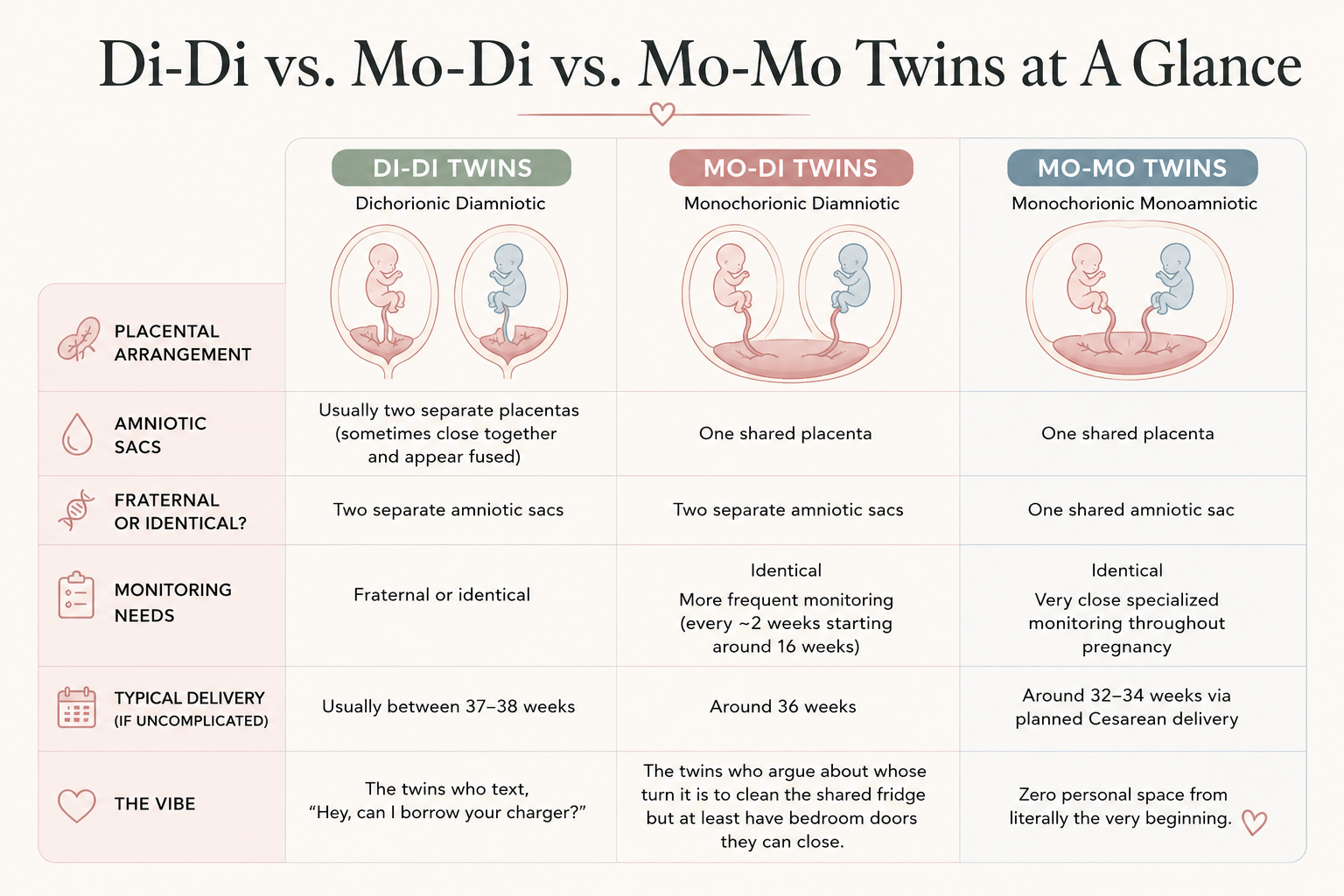
Di-di twins each have their own chorion and their own amniotic sac. They typically have separate placentas, although the two placentas can sometimes sit close together and appear fused on ultrasound.
Basically, they’re living in neighboring apartments.
Di-di twins can be fraternal or identical. Fraternal twins are always di-di because they develop from two separately fertilized eggs. Identical twins can also be di-di if the fertilized egg divides early enough.
Why it matters
Di-di pregnancies generally have fewer twin-specific risks than pregnancies in which the babies share a placenta.
That doesn’t mean a di-di twin pregnancy is treated like a singleton. You’re still carrying two babies, so your team will monitor growth, amniotic fluid, preterm birth risk, and your own health more closely than in a singleton pregnancy.
Those extra checks often include twin pregnancy growth scans throughout pregnancy.
The vibe
The twins who text, “Hey, can I borrow your charger?” instead of walking into each other’s room and taking it.
2. Mo-Di Twins: Monochorionic Diamniotic
The “we share a kitchen, but at least we have separate bedrooms” twins.
Mo-di twins share one placenta but have two separate amniotic sacs. These twins are identical.
Because they share a placenta, blood vessels inside that placenta can connect their circulations. That shared circulation is why mo-di pregnancies need closer monitoring.
One of the main complications providers watch for is Twin-to-Twin Transfusion Syndrome (TTTS), which happens when blood flows unevenly between the twins.
Your team may also monitor for Twin Anemia-Polycythemia Sequence (TAPS) and selective fetal growth restriction (sFGR). These are the main reasons surveillance is more frequent. It does not mean something is already wrong. Sharing a placenta simply comes with specific risks that are easier to manage when caught early.
How often are mo-di twins monitored?
Current recommendations call for ultrasound surveillance for TTTS beginning around 16 weeks and continuing at least every two weeks in uncomplicated mo-di pregnancies.
You can read more about what all those appointments may look like in Twin Pregnancy Ultrasounds: What to Expect Throughout Your Pregnancy.
When are mo-di twins typically delivered?
Delivery timing depends on the individual pregnancy and whether any complications develop.
In an uncomplicated mo-di pregnancy, delivery is commonly recommended around 36 weeks, though your own OB or maternal-fetal medicine specialist will decide the safest timing for you and your babies.
The vibe
The twins who argue about whose turn it is to clean the shared fridge but at least have bedroom doors they can close.
3. Mo-Mo Twins: Monochorionic Monoamniotic
The “we are literally in the same sleeping bag” twins.
Mo-mo twins share one placenta and one amniotic sac. There is no dividing membrane separating the babies. These twins are identical and much less common than di-di or mo-di twins.
Why do mo-mo twins need such close monitoring?
One of the biggest concerns is umbilical cord entanglement and compression.
Because both babies are moving around in the same amniotic sac, their cords can become tangled or compressed, which can affect blood flow. This is why specialized monitoring is required throughout the pregnancy.
Your exact plan may vary depending on your pregnancy, healthcare team, and hospital. Some parents with mo-mo twins are monitored in the hospital later in pregnancy, while others follow a different outpatient surveillance schedule.
When are mo-mo twins typically delivered?
Because of the ongoing risk of cord complications, uncomplicated mo-mo twins are generally delivered earlier than other twin types.
Current international guidance recommends planned Cesarean delivery at approximately 32 to 34 weeks, though your maternal-fetal medicine team will determine the safest timing based on your specific situation.
The vibe
Zero personal space from literally the very beginning.
Honestly, this explains a lot about twins.
Why Your Doctor Cares So Much About Chorionicity
Here’s the part I really want twin parents to understand:
Whether your twins share a placenta can be more important to pregnancy management than simply knowing whether they’re identical or fraternal.
Twins who share a placenta have risks that twins with separate placentas don’t have. That changes how frequently your babies need to be monitored.
That’s why determining chorionicity and amnionicity early in pregnancy is such an important part of the first-trimester ultrasound.
Your healthcare team isn’t just trying to figure out what kind of twins you’re having. They’re figuring out the safest way to monitor them for the rest of the pregnancy.
Questions to Ask at Your Ultrasound
If you’ve recently found out you’re having twins, ask your provider:
Are my twins di-di, mo-di, or mo-mo?
Do they share a placenta?
Do they share an amniotic sac?
How often will I need ultrasounds?
Will I see a Maternal-Fetal Medicine specialist?
Are there specific complications you’ll be monitoring for?
When do you typically recommend delivery for this type of twin pregnancy?
Write the answers down. Pregnancy brain plus a brand-new twin vocabulary is a terrible combination.
My RN and Twin Mom Perspective
As an RN, I understand why knowing chorionicity and amnionicity matters medically. It helps your healthcare team decide what complications to watch for and how frequently your babies should be monitored.
As a twin mom, I also know that hearing all these terms for the first time can feel like someone handed you a medical textbook five minutes after telling you there are two babies in there.
You don’t need to become an expert overnight.
Start with one question: Do my babies share a placenta or an amniotic sac?
Once you know that, the rest of the alphabet soup starts making a whole lot more sense.
💛 Twin Mom Tip
Take a picture of the ultrasound report or write your twin type in the notes app on your phone.
You’ll be asked whether your twins are di-di, mo-di, or mo-mo approximately nine million times during pregnancy, and eventually you’ll be able to answer before they finish the question.
Frequently Asked Questions
-
No. Most di-di twins are fraternal, but di-di twins can absolutely be identical. Roughly 1 in 10 di-di twin pregnancies are estimated to be identical.
-
Yes. Mo-di twins result from one fertilized egg dividing. They share a placenta while having separate amniotic sacs.
-
Yes. Mo-mo twins share both a placenta and an amniotic sac.
-
Mo-mo pregnancies generally require the closest surveillance because the babies share both a placenta and an amniotic sac, creating risks that include umbilical cord entanglement and compression.
Mo-di pregnancies also require additional surveillance because sharing a placenta creates risks such as TTTS, TAPS, and selective fetal growth restriction.
-
Mo-di twins share a placenta and are at risk for complications such as TTTS. Current recommendations call for TTTS surveillance beginning at approximately 16 weeks and continuing at least every two weeks
-
No. Di-di twins generally have fewer twin-specific complications than twins sharing a placenta, but a twin pregnancy still carries increased risks compared with a singleton pregnancy and requires additional prenatal monitoring.
The Bottom Line
Di-di, mo-di, and mo-mo sound complicated until you boil it down to one simple question:
What are the babies sharing?
Di-di twins have the most separate living arrangements.
Mo-di twins share a placenta but have separate amniotic sacs.
Mo-mo twins share both.
The more your babies share, the more specialized monitoring your pregnancy may require.
And eventually, all three arrangements lead to the same place: two little humans outside the womb who somehow still believe everything in your house belongs equally to both of them.
Including the last cookie.
References
American College of Obstetricians and Gynecologists (ACOG). Multiple Pregnancy.
Society for Maternal-Fetal Medicine (SMFM). Consult Series #72: Twin-Twin Transfusion Syndrome and Twin Anemia-Polycythemia Sequence.
International Society of Ultrasound in Obstetrics and Gynecology (ISUOG). Practice Guidelines: Role of Ultrasound in Twin Pregnancy.
International Society of Ultrasound in Obstetrics and Gynecology (ISUOG). Monoamniotic Twin Pregnancy.
Medical Disclaimer
This article is for educational purposes only and should not replace medical advice from your healthcare provider. Twin pregnancies can require different monitoring and delivery plans depending on chorionicity, amnionicity, pregnancy complications, and individual circumstances. Always follow the recommendations of your OB, maternal-fetal medicine specialist, or another qualified healthcare professional.
