Gagging vs. Choking: What's the Difference?
Updated September 17, 2026
One of the biggest fears parents have when starting solids is choking. It's completely understandable. Watching your baby cough, sputter, or gag can be alarming, especially when you're feeding two babies at once.
The good news is that gagging and choking are not the same thing. In fact, gagging is a normal part of learning to eat and is a sign that your baby's body is working to protect their airway.
Understanding the difference can help you stay calm during meals and know when your baby needs support and when it's best to let them work through it on their own.
If you're just getting started, you may also want to read our Starting Solids With Twins: When, How, and What to Expect guide.
What Is Gagging?
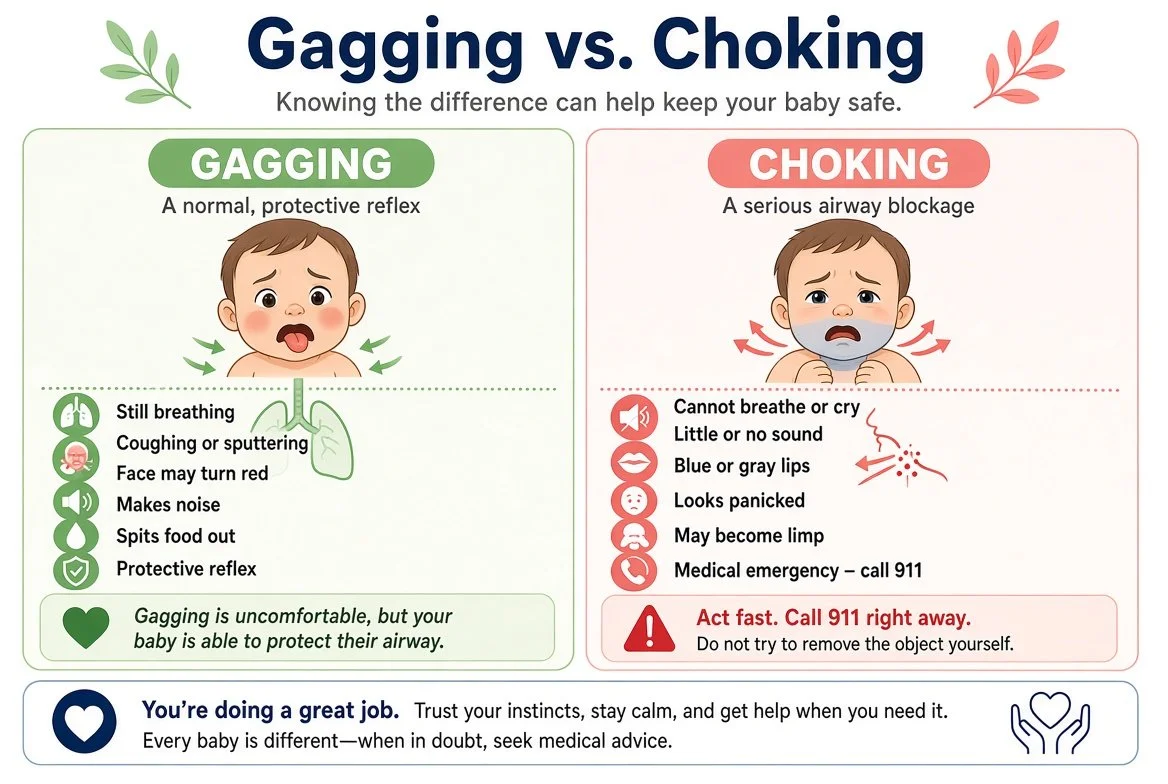
Gagging is a normal protective reflex that helps prevent food from entering the airway.
When babies first begin eating solids, they're still learning how to chew, move food around their mouths, and swallow safely. If food reaches the back of the tongue before they're ready to swallow it, the gag reflex pushes the food forward so they can try again.
While it can look dramatic, gagging is a normal part of developing feeding skills.
What Does Gagging Look Like?
A baby who is gagging may:
Cough or sputter
Open their mouth wide
Stick out their tongue
Make gagging or retching sounds
Turn red in the face
Spit food back onto the tray
The most reassuring sign is that they keep breathing throughout the episode. Air is still moving, and the reflex is doing its job.
What Is Choking?
Choking occurs when food or another object blocks the airway, making it difficult or impossible for a baby to breathe.
Unlike gagging, choking is a medical emergency that requires immediate action.
Recognizing the difference is one of the most important safety skills parents can learn before introducing solids.
What Does Choking Look Like?
A baby who is choking may:
Be unable to cry or make sounds
Be unable to breathe normally
Have a weak or absent cough
Appear panicked
Develop pale, blue, or gray coloring
Become unresponsive if the airway remains blocked
If your baby cannot breathe, cough, or cry, treat it as a choking emergency.
For a responsive choking infant, current American Red Cross guidance recommends cycles of 5 back blows followed by 5 chest thrusts until the object is cleared or the infant becomes unresponsive. If the baby becomes unresponsive, CPR should be started according to your training.
This is why I strongly recommend taking an infant CPR and choking course rather than trying to learn these skills for the first time during an emergency.
Should You Help a Baby Who Is Gagging?
Your first instinct may be to reach into your baby's mouth or quickly remove the food.
In most cases, it's better to pause and observe.
The gag reflex is designed to move food forward and out of the mouth. Reaching inside with your fingers can accidentally push food farther back.
Stay close, watch carefully, and allow your baby time to work through the gag while making sure they continue breathing normally.
If a baby is actually choking, don't perform a blind finger sweep. Current Red Cross guidance recommends removing an object with your finger only when you can actually see it.
How to Reduce the Risk of Choking
While gagging is expected, there are several ways to make mealtimes safer.
Always wait until your babies show signs that they're developmentally ready for solids. Seat them upright in a high chair for every meal and supervise them closely while they eat.
Offer foods that are prepared in age-appropriate sizes and textures, and avoid or modify common choking hazards such as:
Whole grapes
Popcorn
Whole nuts
Chunks of hot dog
Hard candy
Large spoonfuls of nut butter
It's also important to avoid feeding babies while they're crawling, walking, playing, or riding in a stroller or car seat.
If you're trying to decide how you want to introduce food, our Purees vs. Baby-Led Weaning for Twins guide breaks down both approaches. We also have a Baby-Led Weaning With Twins: A Beginner's Guide if that's the route you're considering.

Feeding Two Babies When One Gags
This is where twin parenting gets uniquely stressful.
You're holding a spoon for one baby, watching the other, and suddenly one of them starts gagging loudly. Your heart jumps, and the other twin, who was happily eating, notices the commotion and either stops or starts fussing.
The instinct is to drop everything and focus on the gagging baby. That's the right instinct, but you don't have to completely lose track of the second one.
First, make sure the gagging baby is breathing and that you're dealing with gagging rather than choking. Keep the other twin safely seated in their high chair while you closely watch the baby who is gagging.
Over time, you'll probably get much better at recognizing what normal gagging looks like with each baby.
Your twins may react differently, too. One may barely notice when their sibling gags while the other stops eating to investigate the entire situation.
Because apparently dinner wasn't chaotic enough already.
For more twin-specific strategies, see Managing Mealtimes With Twins.
Consider Taking an Infant CPR Class
One of the best ways to prepare for starting solids is learning infant CPR and choking first aid.
No parent expects to face an emergency, but knowing what to do can make all the difference.
Taking a class before your twins begin solids can also help you feel more confident when normal gagging inevitably happens.
Many hospitals and community organizations offer infant CPR courses, and the American Red Cross provides choking and CPR training for parents and caregivers.
American Red Cross Infant Choking Guidance
What About LifeVac and Other Anti-Choking Devices?
A Note on LifeVac and Infants
This one deserves some clarification because the information around LifeVac has recently changed.
In March 2026, the FDA granted De Novo authorization for LifeVac as a second-line suction anti-choking device. That means it is intended for a complete airway obstruction after standard choking rescue procedures have been attempted without success.
However, there’s a very important detail for parents starting solids:
The FDA-authorized LifeVac is intended for adults and children who are at least 1 year old. It is not authorized for babies under 1 year of age.
So if your twins are starting solids around 6 months old, LifeVac should not replace the infant choking response you learn in CPR training.
Once your children are at least 1 year old, you may decide you want to keep an FDA-authorized second-line suction device in your home as an additional layer of emergency preparedness.
Even then, it does not replace standard choking first aid, CPR training, or emergency medical services. The FDA authorization specifically describes it as a second-line treatment after established choking protocol has been unsuccessful.
A Second-Line Tool Worth Having on Hand (for children 1+)
Learning infant CPR and choking first aid is the most important step you can take. Standard protocols (back blows and abdominal thrusts) should always come first.
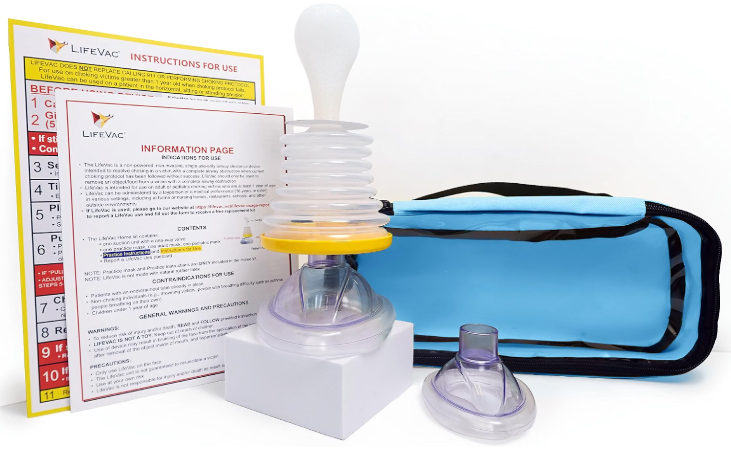
That said, many twin families keep a LifeVac Home Kit once their children reach 1 year of age as a second-line option. It is a non-powered suction device designed to help clear a complete airway obstruction when traditional methods have not worked. The Home Kit includes both an adult and pediatric mask plus a practice mask so you can get familiar with it before you ever need it.
It is not a replacement for CPR training or calling 911. Think of it as an extra layer of preparedness, especially when you’re feeding two toddlers at once and every second counts.
You can find the LifeVac Home Kit here:
LifeVac Home Kit on Amazon
As an Amazon Associate, Twin Mom Club may earn a small commission if you purchase through this link, at no extra cost to you.
Twins May Develop Feeding Skills at Different Times
Even identical twins don't always learn to eat at the same pace.
One twin may confidently explore every new food you place on the tray, while the other gags more often or takes longer to feel comfortable with different textures.
This can be a normal part of development.
Continue offering safe opportunities to practice without comparing your twins or rushing either child through the process.
If you need ideas for what to offer next, see Best First Foods for Twins.
My RN Perspective
One of the biggest concerns parents have when starting solids is that every gag means their baby is choking.
Fortunately, that's not the case.
Learning the difference between gagging and choking can help you respond more calmly and, more importantly, recognize when your baby actually needs emergency help.
I also encourage every parent and caregiver who regularly feeds your babies to learn infant CPR and choking first aid before starting solids.
Hopefully you'll never need those skills.
But feeding two babies at once already comes with enough chaos. Knowing exactly what to do in an emergency is one thing you don't want to be figuring out in the moment.
Dr. Judy's SLP Perspective
Learning to eat is a developmental process that involves much more than swallowing food. Babies are developing the oral motor skills needed to bite, chew, move food around the mouth, and swallow safely.
As these skills mature, occasional gagging is a normal protective response and an expected part of learning to manage different food textures.
While gagging is common, persistent coughing during meals, frequent choking episodes, difficulty progressing to age-appropriate textures, or signs of discomfort while eating should be discussed with a pediatrician or feeding specialist.
Early evaluation can help identify feeding challenges and support safe, successful eating.
💛 Twin Mom Tip
Try your best to stay calm if one of your twins gags during a meal.
I know that's easier said than done when you're staring at two babies and wondering which noise requires you to launch yourself across the kitchen.
Watch closely for the difference between a baby who is loudly gagging but still breathing and a baby who cannot breathe, cry, or cough effectively.
And take the infant CPR class.
It's one of those things you hope you never need, but you'll be glad you learned it.
Helpful Resources
Starting solids with twins means twice the prep, twice the questions, and twice the chances to second-guess yourself. These resources can take some of the guesswork out of it.
Solid Starts offers a searchable food database with information about age-appropriate preparation, textures, and choking hazards.
American Red Cross Infant Choking & First Aid offers information and training on infant CPR and choking first aid.
HealthyChildren.org is the American Academy of Pediatrics' parent education website and includes information about feeding, starting solids, and choking prevention.
These won't replace your pediatrician's guidance, but they're solid starting points when you're standing in the kitchen at 6 a.m. wondering what to put on two trays.
Frequently Asked Questions
-
Yes. Gagging is a normal protective reflex that helps babies learn to manage food in their mouths. It is common while babies are developing feeding skills.
-
No. Don't perform a blind finger sweep. If your baby is choking, follow the choking response you've learned in infant CPR or first-aid training. Current Red Cross guidance says an object should only be removed with a finger if you can actually see it.
-
Gagging can happen with both spoon-feeding and baby-led weaning as babies learn to manage different foods and textures. Regardless of which feeding approach you use, foods should be prepared appropriately for your baby's developmental abilities.
-
If your infant cannot breathe, cough, or cry, treat it as a choking emergency. Current American Red Cross guidance for a responsive choking infant recommends cycles of 5 back blows followed by 5 chest thrusts until the object is cleared or the infant becomes unresponsive. If the baby becomes unresponsive, begin CPR according to your training and call 911 (or have someone else call). This is why taking an infant CPR and choking course before starting solids is so important.
-
The LifeVac device authorized by the FDA in 2026 is indicated for adults and pediatric patients at least 1 year old. It is a second-line device intended for complete airway obstruction after standard choking protocols have been attempted without success.
-
Talk with your pediatrician if your baby frequently chokes, has persistent coughing during meals, struggles to swallow, has difficulty advancing to new textures, shows signs of discomfort while eating, or isn't gaining weight appropriately.
Related Twin Feeding Guides
Purees vs. Baby-Led Weaning for Twins: Which Is Right for Your Family?
Do Twins Reach Milestones at the Same Time? Here's What I Learned
References
American Red Cross. Infant Choking: How to Help.
American Red Cross. Management of Foreign Body Airway Obstruction.
U.S. Food and Drug Administration. De Novo Classification Request for LifeVac, DEN250012. March 4, 2026.
American Academy of Pediatrics. HealthyChildren.org.
Medical Disclaimer
This article is for educational purposes only and does not replace medical advice, first-aid training, CPR training, or emergency medical care. Information is current as of the publication date and may change. If your child is choking or experiencing another medical emergency, call 911 or your local emergency number and follow current emergency-response guidance.
