Prenatal Vitamins for Twin Pregnancy: What Twin Moms Should Look For
I recently went down one of those rabbit holes where I was comparing two prenatal vitamins from the same company and somehow ended up with 14 tabs open trying to figure out what was actually different.
Very relaxing pregnancy activity.
Once you start reading prenatal labels, it gets confusing fast. Folate versus folic acid. Choline. Iron. DHA. Iodine. Different forms of B12. One bottle has two capsules a day, another has eight.
Then add a twin pregnancy to the equation and there’s another obvious question: Do you need more prenatal vitamins because you’re growing two babies?
Not exactly.
Two babies does not mean two servings of your prenatal. In fact, taking extra prenatal vitamins on your own can give you too much of nutrients that have established upper limits. The National Institutes of Health notes that there are currently no formal separate Dietary Reference Intakes specifically for twin or higher-order pregnancies, largely because the research is still limited.
That doesn’t mean nutrition isn’t especially important when you’re carrying twins. It absolutely is. It means your prenatal should be the starting point, not something you blindly double because there are two babies in there.
Do Twin Moms Need a Special Prenatal Vitamin?
There isn’t one magical “twin prenatal” that every twin mom needs.
The NIH specifically notes that research on nutritional needs in multiple pregnancies is limited and that no formal nutrient recommendations have been established specifically for women carrying multiples.
At the same time, twin pregnancies can come with additional nutritional considerations. Anemia is a bigger concern in twin pregnancies. Some specialty multiple-pregnancy programs recommend higher folic acid and iron intake for twin moms, while research comparing higher doses has produced mixed results.
So this is one of those areas where your OB or MFM matters more than whatever prenatal vitamin is trending on TikTok this week. Your needs may depend on your diet, lab work, medical history, medications, and how your pregnancy is progressing.
What Should You Look for in a Prenatal Vitamin for Twins?
I wouldn’t choose a prenatal based only on how many nutrients are listed on the front of the bottle. Turn it around.
Here are some of the nutrients worth looking for.
Folate and Folic Acid
This one gets confusing quickly because the words are often used interchangeably online, but they aren’t exactly the same thing.
Folate is vitamin B9. Folic acid is one form of folate, and it is the form that has been directly studied and shown to help prevent neural tube defects.
ACOG currently recommends 600 mcg of folic acid per day during pregnancy, including at least 400 mcg from a prenatal vitamin beginning before pregnancy when possible. ACOG also specifically notes that folic acid is the form with evidence showing prevention of neural tube defects.
Some prenatal vitamins use other forms, including methylfolate and folinic acid. That doesn’t mean you need to immediately declare one form good and another bad. It does mean you should know what’s actually in your prenatal and discuss it with your OB or MFM, particularly if your prenatal doesn’t contain folic acid.
Twin pregnancies make this conversation even more interesting because some multiple-pregnancy specialists recommend higher folate intake than the standard pregnancy recommendation. However, there is not one universally established twin-specific dose.
Iron
Pregnancy increases iron needs because your body is making more blood to support you and your growing baby.
Or babies.
ACOG recommends 27 mg of iron per day during pregnancy for the general pregnant population. Twin pregnancy deserves some additional attention here because anemia is more common with multiples.
But here’s where I really don’t love blanket advice telling every twin mom to just take more iron.
The NIH reviewed the limited research available in twin pregnancies. One study found that 54 mg of iron didn’t prevent iron-deficiency anemia better than 27 mg in twin moms who were not already anemic, and the higher dose caused more side effects. Another study involving women with iron deficiency found benefits from the higher iron dose.
Basically: your labs matter.
Have your healthcare provider monitor you for anemia and ask whether you need additional iron rather than adding a bunch on your own.
Choline
Choline is one of the nutrients I started paying much more attention to once I actually began comparing prenatal labels. It’s important for fetal brain and nervous system development, and the recommended intake during pregnancy is 450 mg per day.
And here’s the annoying part. A lot of prenatals don’t contain much of it.
The NIH notes that less than half of prenatal supplements on the U.S. market contain choline, and even those that do often contain relatively small amounts. Food sources include eggs, meat, dairy, soy products, and peanuts.
So don’t look at the word “prenatal” on the bottle and assume your choline needs are automatically covered.
Iodine
Iodine supports thyroid function and fetal brain and nervous system development. The recommended intake during pregnancy is 220 mcg per day.
People who don’t regularly eat dairy, seafood, or eggs, or who don’t use iodized salt, may have more difficulty getting enough iodine through food alone.
This is another nutrient worth checking on the actual Supplement Facts label instead of assuming it’s there.
DHA and Omega-3s
DHA is an omega-3 fatty acid that plays an important role in fetal brain and eye development.
Some prenatal vitamins include DHA. Some don’t.
Some companies deliberately sell DHA separately so a meaningful amount can be taken without cramming yet another ingredient into an already giant prenatal capsule.
Neither setup automatically makes a prenatal better or worse. It just means you need to know whether your prenatal includes DHA or whether you and your healthcare provider want to add a separate omega-3 supplement.
ACOG recommends eating two to three servings of lower-mercury fish or shellfish per week during pregnancy as another source of omega-3 fatty acids.
Vitamin D and Calcium
Calcium and vitamin D are also important during pregnancy.
For pregnant adults ages 19 to 50, ACOG lists daily targets of 1,000 mg of calcium and 600 IU of vitamin D.
That does not mean your prenatal needs to contain the entire amount. You’re eating food too. Hopefully.
Calcium especially can take up a lot of physical space in a supplement, so many prenatals rely on food to provide part of your daily intake.
Please Check the Serving Size
This deserves its own section because supplement companies apparently enjoy making this unnecessarily complicated.
One prenatal may say:
Serving size: 1 capsule
Another:
Serving size: 2 capsules
Another:
Serving size: 8 capsules
If you compare the nutrient amounts without noticing the serving size, you’re not actually comparing the products correctly.
And before ordering anything, ask yourself a very unscientific but extremely important question:
Will I actually take this every day?
A beautiful supplement label doesn’t help much if eight capsules make you want to throw the bottle across the kitchen.
What I’m Taking This Pregnancy: Seeking Health Optimal Prenatal
Affiliate disclosure: Twin Mom Club may earn a commission when you purchase through links on this page, at no additional cost to you. I only include products that I believe are relevant to the topic, and supplements should always be discussed with your healthcare provider during pregnancy.
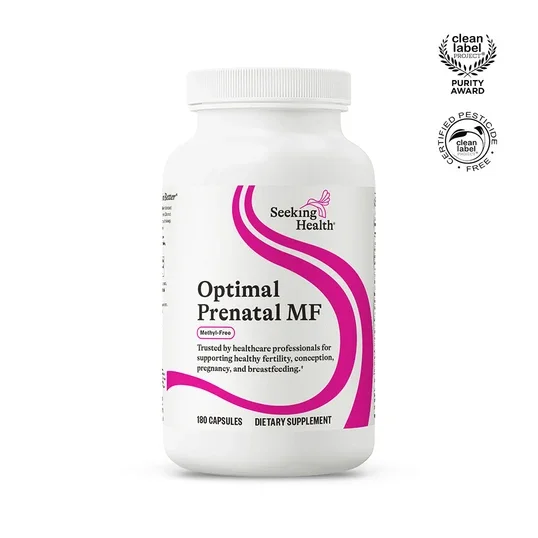
For this pregnancy, I chose Seeking Health Optimal Prenatal.
When I started comparing prenatal vitamins, I wanted to pay closer attention to what was actually on the Supplement Facts label instead of assuming every prenatal covered the same nutrients.
Optimal Prenatal stood out to me because it has a more comprehensive nutrient profile and includes nutrients I was specifically looking for, including choline, methylfolate and folinic acid, along with active forms of B12, vitamin B6, ginger, myo-inositol and other nutrients.
Its suggested full serving is eight capsules per day, divided throughout the day.
What I chose this pregnancy
I wanted a prenatal with a more comprehensive nutrient profile, including choline and active B vitamins. I’m currently taking Optimal Prenatal and will update this guide with my experience as I use it.
There are two things I think are especially important to know before looking at the front of the bottle and assuming it’s a complete pregnancy regimen.
Optimal Prenatal does not contain iron or DHA.
Seeking Health intentionally leaves those out of the prenatal and recommends considering separate iron and fish oil products instead.
That isn’t automatically a negative. In fact, separating iron can make sense when iron needs are being individualized based on lab work.
But it is absolutely something I want twin moms to know before buying it.
You don’t want to spend money on a prenatal and discover three weeks later that the nutrient you thought was in there wasn’t.
What About the Seeking Health Prenatal Bundle?
Seeking Health also offers a Prenatal Comprehensive Support Bundle, and this is the bundle that contains Optimal Prenatal, not Prenatal Essentials.
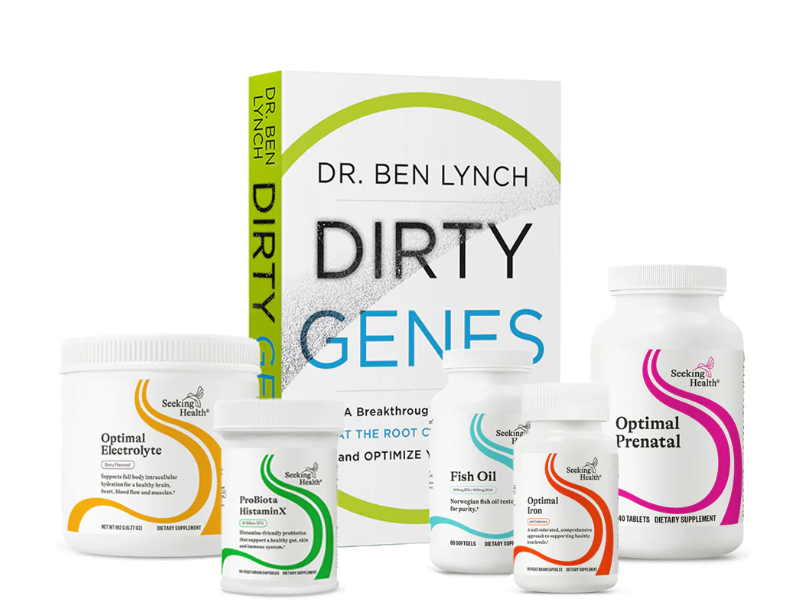
The current bundle includes:
Optimal Prenatal
Fish Oil
Iron with Cofactors
ProBiota HistaminX
Optimal Electrolyte
A copy of Dirty Genes
Seeking Health currently lists the bundle at a discount compared with purchasing the included products separately.
Would I tell every pregnant woman she needs the entire bundle?
No.
That’s exactly the kind of supplement advice I don’t want Twin Mom Club giving.
Your iron needs may be different from mine. Your diet may already provide plenty of certain nutrients. You may already take DHA. Your provider may want something completely different based on your labs.
The bundle is an option, not a pregnancy requirement.
My Prenatal Vitamin Checklist
If you’re standing in the supplement aisle with three bottles in your hand and absolutely no idea which direction your life has taken, start here.
Check:
The serving size
The type and amount of folate
Whether it contains iron
How much choline it contains
Whether it contains iodine
Whether DHA is included or separate
The vitamin D amount
Any other supplements you’re taking that may duplicate nutrients
Whether you can realistically take the required number of capsules every day
Whether your OB or MFM has recommended anything additional based on your labs
And especially with twins, don’t assume more automatically equals better.
So, What’s the Best Prenatal Vitamin for Twins?
I wish there were one bottle I could point to and say:
This. Every twin mom. Done.
There isn’t.
The NIH specifically says there aren’t formal twin-specific nutrient recommendations because the evidence is still limited.
What we do know is that pregnancy nutrition matters, twin pregnancies deserve closer nutritional attention, and nutrients including folate, iron, choline, iodine, DHA, vitamin D, and calcium are worth paying attention to.
Your prenatal is one piece of that.
Your food matters.
Your labs matter.
And your individual pregnancy matters.
So read the back of the bottle, not just the marketing on the front, and bring your actual supplement list to your OB or MFM.
Because apparently growing two humans wasn’t enough homework.
References
American College of Obstetricians and Gynecologists. Healthy Eating During Pregnancy.
National Institutes of Health Office of Dietary Supplements. Dietary Supplements and Life Stages: Pregnancy.
Centers for Disease Control and Prevention. About Folic Acid.
Brigham and Women’s Hospital. Twin Pregnancy Obstetric Care Guidelines.
Brigham and Women’s Hospital. Meeting Your Nutritional Goals During a Twin Pregnancy.
Seeking Health. Optimal Prenatal.
Seeking Health. Prenatal Comprehensive Support Bundle.
Medical Disclaimer
This article is for general educational purposes only and does not replace individualized medical advice. Pregnancy supplement needs vary. Talk with your OB, MFM, registered dietitian, or other qualified healthcare professional before starting, stopping, or changing supplements during pregnancy.
